
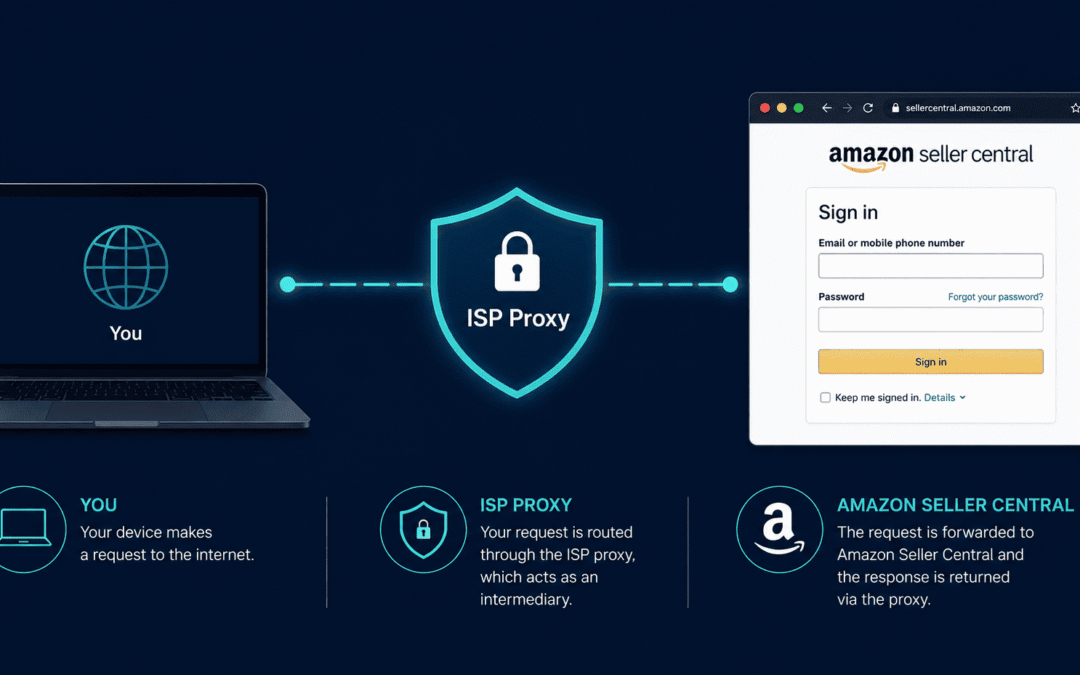
If you sell on Amazon, you already know how strict the platform is about accounts. Account suspensions have increased by 12 percent year over year in 2026 as Amazon tightened policy enforcement, according to a report by Thunderbit. Even one wrong signal can flag, restrict, or suspend your seller account without much warning. A big part of that signal comes from something most sellers never think about: their IP address.
This guide breaks down what ISP proxies are, why they matter for Amazon FBA sellers, and how to pick the right one for your business.
Why Your IP Address Matters on Amazon
Every time you log into Seller Central, Amazon records the IP address you connected from. Over time, this builds a pattern tied to your account. Amazon uses this pattern along with your browser and device details to check whether the person logging in is really who they say they are, and whether that account is connected to any other seller.
This matters a lot if you run more than one seller account, work with an agency managing several client stores, or use a team of virtual assistants to help manage your store. In all of these cases, an unstable or shared IP address can make Amazon think something suspicious is going on, even though your business is completely legitimate.
Amazon has good reason to be cautious. Seller account suspensions have been a widespread issue. Once an account is flagged, getting it reinstated can be a slow and frustrating process, especially when your FBA inventory is sitting in Amazon’s warehouses while your account is under review.
Get started with premium ISP proxies by Express Nodes to secure your seller account.
Premium Proxy Infrastructure
Residential Proxies
🏡
Your content goes here. Edit or remove this text inline or in the module Content settings. You can also style every aspect of this content in the module Design settings and even apply custom CSS to this text in the module Advanced settings.
ISP IPs
🏡
Your content goes here. Edit or remove this text inline or in the module Content settings. You can also style every aspect of this content in the module Design settings and even apply custom CSS to this text in the module Advanced settings.
Fresh IPs
🏡
Your content goes here. Edit or remove this text inline or in the module Content settings. You can also style every aspect of this content in the module Design settings and even apply custom CSS to this text in the module Advanced settings.
Dedicated IPs
🏡
Your content goes here. Edit or remove this text inline or in the module Content settings. You can also style every aspect of this content in the module Design settings and even apply custom CSS to this text in the module Advanced settings.
What Is an ISP Proxy?
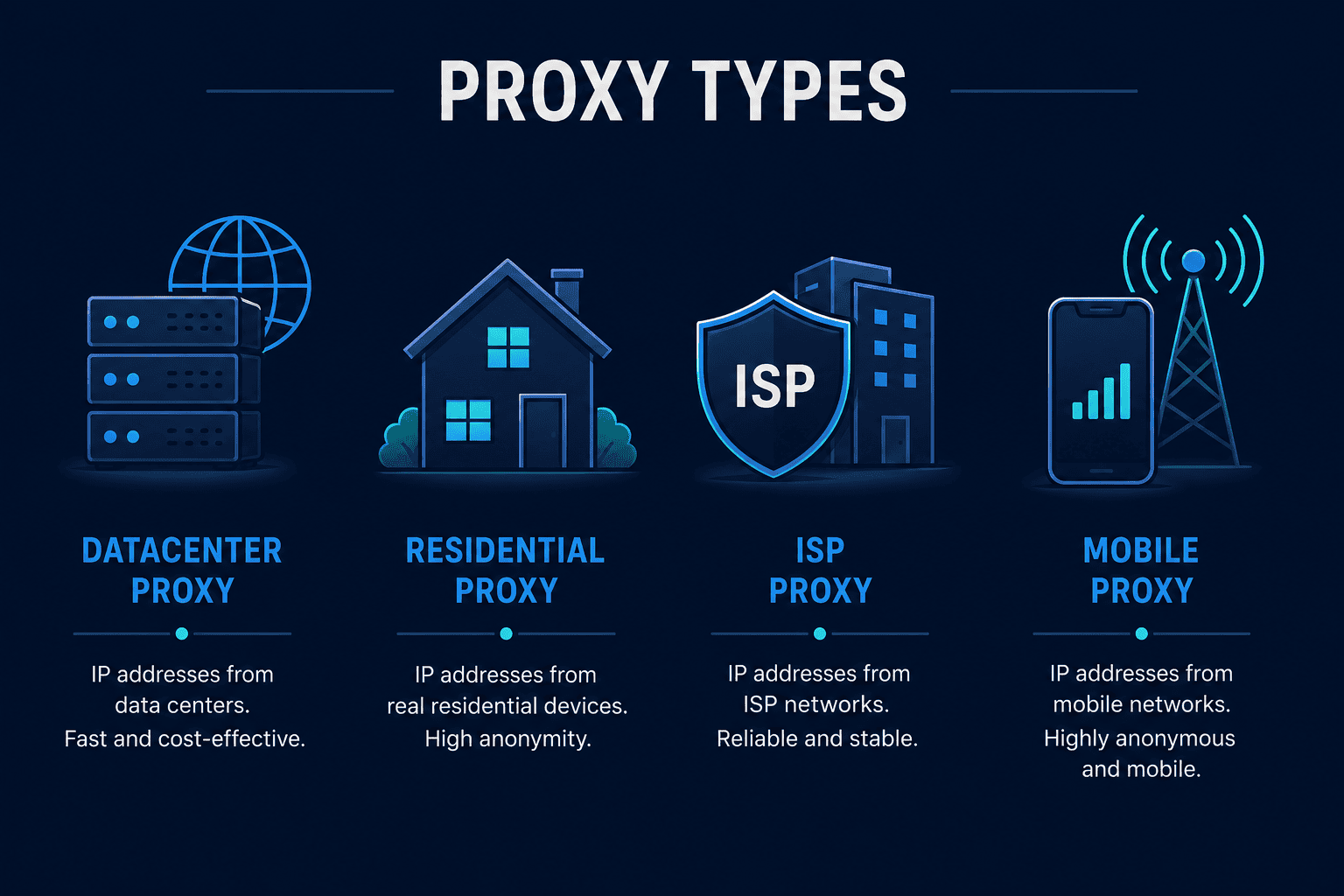
An ISP proxy, sometimes called a static residential proxy, is an IP address that is registered to a real internet service provider but hosted on server-grade infrastructure. In simple terms, it looks like a normal home internet connection, but it runs with the speed and stability of a data center.
This combination is what makes ISP proxies useful for Amazon sellers. Amazon’s systems generally trust IPs that come from real ISPs because that is what genuine shoppers and sellers use. ISP proxies also don’t change every few minutes the way many residential proxies do, so your login pattern stays consistent, which is exactly what Amazon looks for in a legitimate seller.
ISP vs Residential vs Datacenter vs Mobile Proxies
Not every type of proxy works well for Amazon seller account management. Here is a simple breakdown of how the main types compare.
|
Proxy Type |
Looks Like |
Stability |
Best Use Case for Amazon Sellers |
|
Datacenter |
A server, not a real user |
Very stable |
Not recommended, easily flagged by Amazon |
|
Rotating Residential |
A different home user each time |
Low, IP changes often |
Market research, competitor price checks |
|
ISP (Static Residential) |
A real home or business connection |
High, same IP stays |
Daily Seller Central logins, long-term account management |
|
Mobile |
A phone on a carrier network |
High, but shared with many users |
High-risk accounts, travel access, backup option |
For the day-to-day work of running a seller account, logging in, managing listings, checking orders, and handling customer messages, an ISP proxy offers the best mix of both trust and stability. Rotating proxies are useful for tasks like checking how your listing looks in different regions, but they are very risky to use for actual account logins since Amazon can read frequent IP changes as unusual behavior.
Don’t let a shared or flagged IP put your seller account at risk. Buy premium ISP proxies by Express Nodes today.
How Amazon Connects Accounts Through IP Addresses
Amazon doesn’t only look at your IP address on its own. It also combines that with your browser fingerprint, which includes very small details like your screen resolution, installed fonts, and browser settings. Even so, IP address remains one of the strongest signals Amazon relies on to decide whether two accounts might be connected.
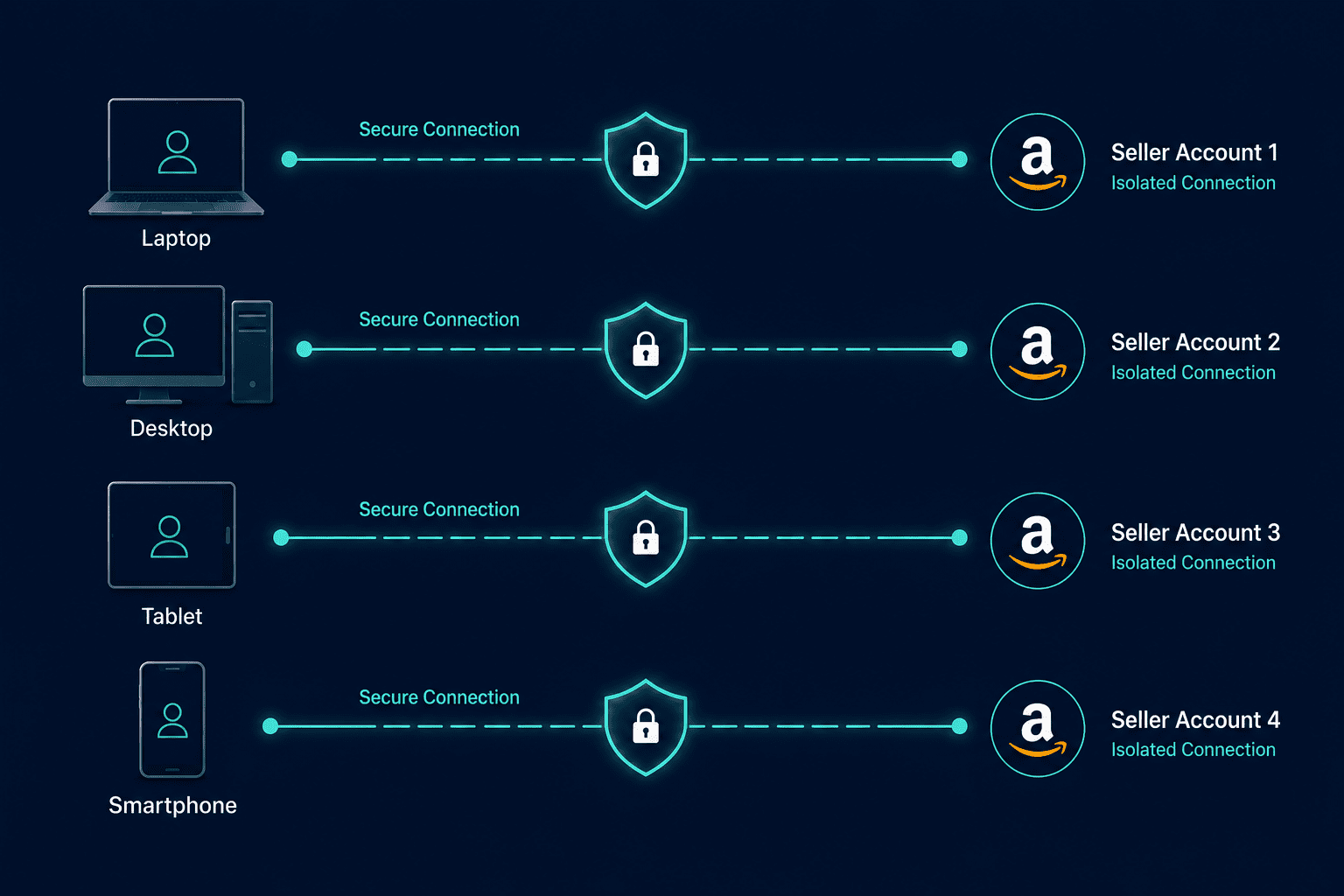
This is why sharing a single IP across multiple seller accounts, even accidentally through office WiFi or a shared laptop, can put every one of those accounts at risk. If one account runs into a policy issue, the others linked to the same IP can get pulled into the review as well.
A dedicated ISP proxy per account keeps this risk contained. Each account gets its own clean, consistent connection that has no history tied to any other seller.
What to Look For in an ISP Proxy for Amazon FBA
Not all ISP proxies are equal. Here are a few things to keep in mind before purchasing one.
Clean IP history. Ask if the IP has been used before and whether it has been checked against known blacklists. A previously flagged IP can cause problems from day one.
Dedicated IP. The IP should only belong to you, not shared with any other customer of the proxy provider. A shared IP brings back the same linking risk you’re trying to avoid.
Matching location. Your proxy should be based in the same country, and ideally the same general region, as the marketplace where your account is registered.
Stable, sticky sessions. The IP should stay the same across sessions rather than rotate. Amazon expects to see the same connection pattern every time you log in.
Good speed and uptime. Seller Central, especially FBA reports and inventory pages, can be very data-heavy. A slow or unreliable connection makes daily account management difficult.
A Simple Setup Checklist
If you’re setting up ISP proxies for Amazon seller account management, keep this basic order in mind.
- Set up separate business details for each account first, including bank account, phone number, and email.
- Choose one dedicated ISP proxy per seller account, matched to the right marketplace region.
- Verify the IP is clean before using it to log in.
- Spend some time browsing normally on that IP before creating or logging into the seller account, so the connection has some natural activity history.
- Keep that same IP consistent for that account going forward. Avoid switching it unless there’s a real reason to.
Do I need a proxy if I only run one Amazon seller account?
It’s not necessary, but it can still help if you travel often or log in from different networks, since a stable IP tied to your account’s region reduces the chances of unexpected verification requests.
Is it against Amazon's rules to use a proxy?
Amazon does not prohibit VPNs or proxies outright, but it does restrict operating multiple seller accounts without any valid business reason. Any proxy use should support a legitimate, policy-compliant setup rather than an attempt to bypass Amazon’s account rules.
Can a VPN work instead of an ISP proxy?
A VPN only changes your visible IP address. It does not address the browser and device fingerprint details Amazon also checks, and VPN IPs are often shared or already known to Amazon’s systems, which makes them less reliable for daily seller account use.
How much does a dedicated ISP proxy usually cost?
Pricing varies by provider and region, but dedicated ISP proxies are generally priced higher than shared or rotating residential options because you get an exclusive IP that no one else uses.
Do agencies managing multiple client accounts need separate proxies for each client?
Yes. Each client account should run on its own dedicated IP to keep client businesses fully separated and to avoid any accidental linking between unrelated seller accounts.
Common Mistakes Sellers Make
Many sellers run into trouble not because proxies don’t work, but because of how they’re used. A few patterns worth avoiding:
- Using the same proxy or the same home WiFi for more than one seller account
- Switching IPs frequently for an account that should stay on one stable connection
- Choosing the cheapest shared proxy without checking its history
- Logging into a brand-new proxy and a brand-new seller account on the same day, with no warm-up activity beforehand
Switch to a dedicated ISP proxy now to secure your Amazon business. Get started with premium ISP proxies by Express Nodes.
Buy Mobile Proxies: Complete Guide 2026
More than 3 billion people now have a 5G subscription, according to the Ericsson Mobility Report (June 2026). Carriers put thousands of subscribers behind each shared IP address, and websites know it. That is why mobile traffic gets so much room, and why mobile...
How to Test Proxy Speed, Latency & Reliability
Most people pick a proxy, plug it in, and only find out it's bad when their scraper starts failing at 2 a.m. That's actually a really painful way to learn. In Proxyway's 2026 benchmark, residential proxies succeeded about 99% of the time on a simple test page, but the...

Static vs. Rotating Residential Proxies: Which Is Better?
Automated traffic made up more than 53% of all web traffic in 2025, according to Imperva's 2026 Bad Bot Report. Websites know this, and they've gotten strict about who they let in. If your IP looks suspicious, you get a CAPTCHA, a block, or sometimes a quietly fake...