

If you have ever tried to run more than one Amazon account from the same laptop, you already know how difficult it is. One day, everything is working properly, and then, after a day, you get a notification that your account has been flagged due to related account activity. It’s not always because you did something shady, but Amazon saw you logging in to two different accounts with the same IP address.
This is where proxies for Amazon account creation and management come in to help. Amazon suspends thousands of seller accounts every month, and a huge part of those suspensions is because of account linking issues rather than the actual violations of policies. In fact, many sellers have reported that suspensions now affect roughly a third of all active accounts at some time, often triggered by IP overlap or a shared device fingerprint. If you are managing multiple stores, running dropshipping operations, or you simply want to create a backup account the right way, picking the right proxy is not optional anymore. It is one of the most important things you can actually get right.
In this complete guide, we will break down which proxy type actually works for Amazon, how to use it without raising any red flags, and what you should avoid completely.
Why Amazon Is So Strict About IP Addresses
Amazon does not just look at what you sell, but also at how you connect. Every login, every listing update, and every checkout gets checked against a web of signals like your IP address, browser fingerprint, and cookies. When two accounts share the same IP too often, Amazon’s system assumes they are connected with each other, even if the sellers involved have never met.
That is exactly why datacenter proxies, the cheap ones you find flooding search results, are a really bad idea for Amazon. These IPs belong to server farms, not actual homes, so Amazon’s system spots them easily. You may feel like you are saving money, but in reality, you may end up paying for it through an account suspension instead.
Ready to set your accounts up the safe way? Check our proxy plans and get started with a proxy built specifically for Amazon sellers.
Premium Proxy Infrastructure
Residential Proxies
🏡
Your content goes here. Edit or remove this text inline or in the module Content settings. You can also style every aspect of this content in the module Design settings and even apply custom CSS to this text in the module Advanced settings.
ISP IPs
🏡
Your content goes here. Edit or remove this text inline or in the module Content settings. You can also style every aspect of this content in the module Design settings and even apply custom CSS to this text in the module Advanced settings.
Fresh IPs
🏡
Your content goes here. Edit or remove this text inline or in the module Content settings. You can also style every aspect of this content in the module Design settings and even apply custom CSS to this text in the module Advanced settings.
Dedicated IPs
🏡
Your content goes here. Edit or remove this text inline or in the module Content settings. You can also style every aspect of this content in the module Design settings and even apply custom CSS to this text in the module Advanced settings.

The Proxy Types That Actually Work
Residential Proxies
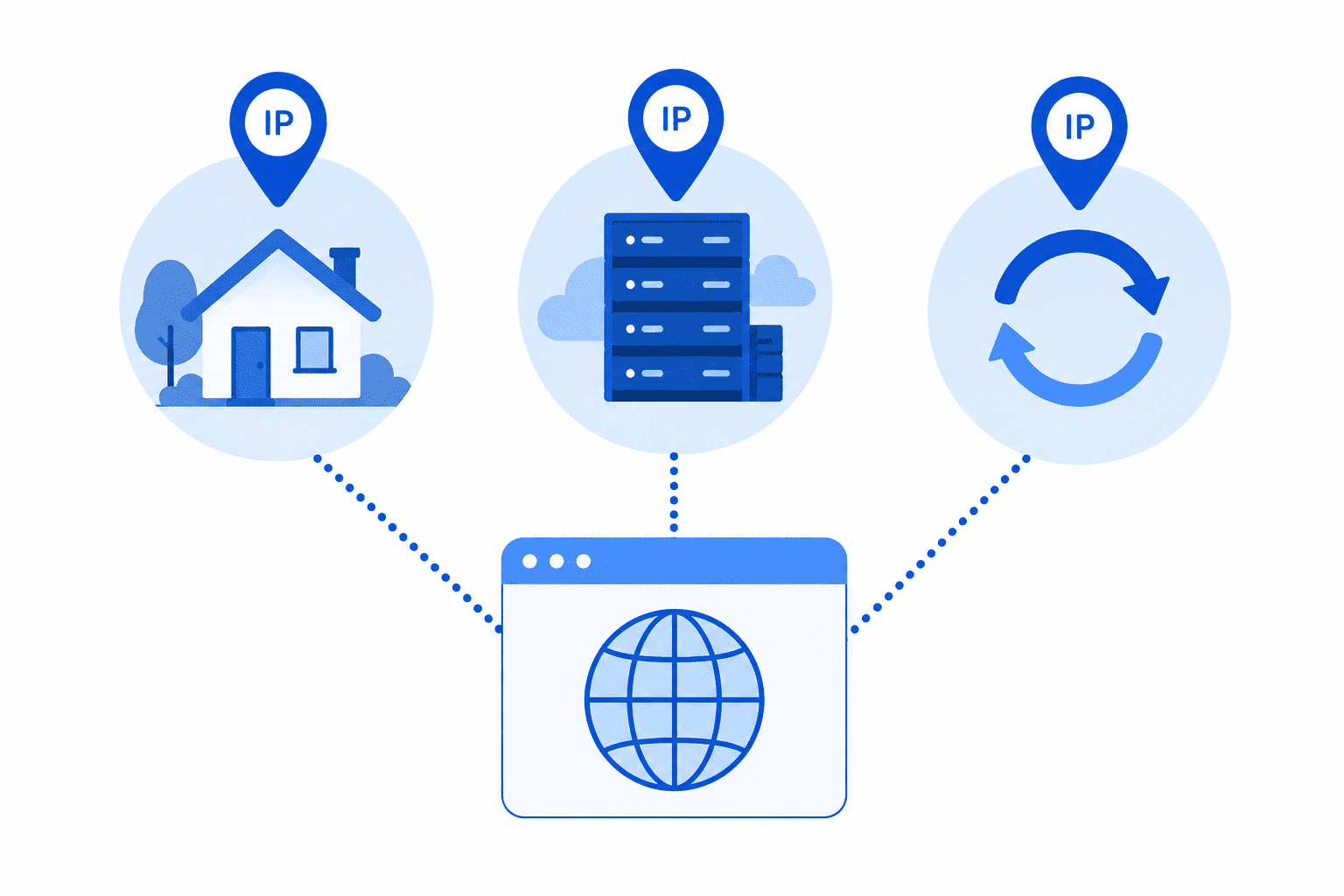
Residential proxies route your traffic through real IP addresses assigned by internet service providers to actual homes. So Amazon sees your connection exactly like a regular shopper browsing from their living room. This is the safest option for creating new Amazon accounts and for day-to-day account management, since the IP carries genuine trust with Amazon’s system.
Rotating Residential Proxies
These are best for research tasks like tracking prices, scraping product listings, or checking stock across different regions. Because the IP changes automatically with each request, it acts like thousands of different shoppers browsing at once. This is a great way to gather data quickly, but it’s actually not ideal for logging into the same seller account repeatedly, since Amazon prefers to see a stable IP for account sessions rather than one that keeps switching around.
Dedicated (Static) Residential Proxies
If you are managing a seller account for the long term, a dedicated proxy is usually the better choice. You get one fixed IP tied only to you, so every login, listing update, and customer message comes from the same trusted location. This consistency is exactly what keeps you safe from Amazon’s related-account detection system. Pair one dedicated IP with one account, and you have built a clean digital footprint that looks like a single real person running their business.
ISP Proxies
ISP proxies combine the speed of a datacenter connection with the trust of a residential IP, since they are hosted on datacenter servers but registered under real internet service provider names. They work well for account management too, though residential and dedicated residential IPs remain the gold standard when Amazon’s detection is involved.
Datacenter vs Residential Proxies for Amazon
|
Feature |
Datacenter Proxies |
Residential Proxies |
|
IP source |
Data center servers |
Real ISPs and households |
|
Amazon trust level |
Low, easily flagged |
High, blends in with real shoppers |
|
Best for |
Nothing Amazon-related |
Account creation, logins, and browsing |
|
Speed |
Very fast |
Fast, slightly slower than DC |
|
Cost |
Cheapest |
Higher, but far fewer bans |
|
Suspension risk |
High |
Low when used correctly |
Need a proxy that actually holds up to Amazon’s checks? See our residential proxy plans and get one set up in minutes.
Setting Up Multiple Amazon Accounts the Right Way
Amazon actually allows multiple seller accounts in specific cases, such as running separate brands or operating in different regions, but only if you follow their rules. Here’s how to do it without raising any flags.
One IP, one account: Never log in to two Amazon accounts from the same IP. Assign a separate, dedicated residential proxy to every account you manage.
Match your location: If your business is registered in a specific city or state, use a proxy IP from that same region. A mismatch between your billing address and your login location is a very easy red flag.
Keep sessions sticky: Avoid switching IPs mid-session. Constantly changing IPs during checkout or account setup looks suspicious, even if the intent is harmless.
Use a separate browser profile: Combine your proxy setup with a clean browser profile or an antidetect browser for each account, so the cookies and cache do not create a trail back to your other accounts.
Warm up new accounts slowly: Do not list dozens of products on day one. Behave like a genuine new seller, gradually adding listings and building order history.
Common Mistakes That Get Accounts Suspended
Even with proxies in place, most of the sellers still make these common mistakes:
- Reusing the same payment method or phone number across accounts.
- Sharing a warehouse or 3PL address without disclosing it to Amazon.
- Switching proxy locations frequently instead of sticking to one dedicated IP.
- Using a free or public proxy, which is almost always shared with hundreds of different users and is already blacklisted.
Amazon’s enforcement has become very strict, with automated systems now scanning connections between accounts before a single complaint is even filed. It’s better to get your infrastructure right from day one rather than fighting with suspensions later.
Choosing a Proxy Provider for Amazon
Before you commit to a provider, check for these things:
- Look for clean, ethically sourced residential IPs, not recycled or blacklisted ones.
- Sticky session support, so your IP stays fixed for as long as you need it, not just for a few minutes.
- City and ISP-level targeting, so you can match your proxy location to your actual business address.
- Keep the setup simple, so you don’t need to be a developer to get it running.
At Express Nodes, this is exactly what we focus on. Our dedicated proxies are built for sellers who need one stable, trusted IP per account, whether that’s for account creation, daily management, or long-term scaling. If your work also involves research and price tracking, our rotating residential proxies handle that side without touching your main account sessions.
Can I use the same proxy for multiple Amazon accounts?
No. Using one proxy IP across multiple accounts is one of the fastest ways to get flagged for related account activity. Always use a separate, dedicated proxy for each account you manage.
Are residential proxies better than datacenter proxies for Amazon?
Yes. Residential proxies use IPs tied to real households, which blend in with genuine shopper traffic. Datacenter IPs are easier for Amazon to detect and are far more likely to trigger bans or CAPTCHA loops.gs.
Do free proxies work for Amazon account creation?
Free proxies are rarely safe for Amazon. They are typically shared by thousands of users, already flagged in Amazon’s system, and offer no session stability, which makes them one of the riskiest options available.
How many Amazon accounts can I manage with proxies?
There is no fixed limit, but each account needs its own dedicated IP, its own browser profile, and ideally its own business justification if Amazon ever asks. Scaling too fast without this structure increases suspension risk.
Will a proxy guarantee that my Amazon account never gets suspended?
No proxy can offer a full guarantee, since Amazon also looks at account behavior, documentation, and performance metrics. A good proxy setup lowers the risk a lot, but it works best alongside clean business practices.
Wrapping Up
Proxies alone cannot guarantee your Amazon account stays safe forever, but skipping them or using the wrong type of proxy is one of the fastest ways to get suspended. So here’s what to do: use residential or dedicated proxies, keep one IP per account, and treat every account the way Amazon expects a genuine seller to actually behave.
Buy Mobile Proxies: Complete Guide 2026
More than 3 billion people now have a 5G subscription, according to the Ericsson Mobility Report (June 2026). Carriers put thousands of subscribers behind each shared IP address, and websites know it. That is why mobile traffic gets so much room, and why mobile...

How to Test Proxy Speed, Latency & Reliability
Most people pick a proxy, plug it in, and only find out it's bad when their scraper starts failing at 2 a.m. That's actually a really painful way to learn. In Proxyway's 2026 benchmark, residential proxies succeeded about 99% of the time on a simple test page, but the...

Static vs. Rotating Residential Proxies: Which Is Better?
Automated traffic made up more than 53% of all web traffic in 2025, according to Imperva's 2026 Bad Bot Report. Websites know this, and they've gotten strict about who they let in. If your IP looks suspicious, you get a CAPTCHA, a block, or sometimes a quietly fake...