

If you have ever tried buying proxies for the first time, you may have gotten confused between datacenter and residential proxies. Let me help you choose the one based on your needs. The one thing you should be careful about is that bot detection systems have gotten stronger at telling the two apart. According to Imperva’s 2025 Bad Bot Report, automated traffic crossed 51% of all web requests in 2024, the first time bots actually outnumbered human traffic online.
That’s why it’s actually very important for you to choose the right type of proxy; otherwise, you may get banned within hours of starting a project. In this guide, we’ll break down what actually separates datacenter proxies from residential proxies, where each one works best, and how to decide which one you actually need.
What Are Datacenter Proxies?
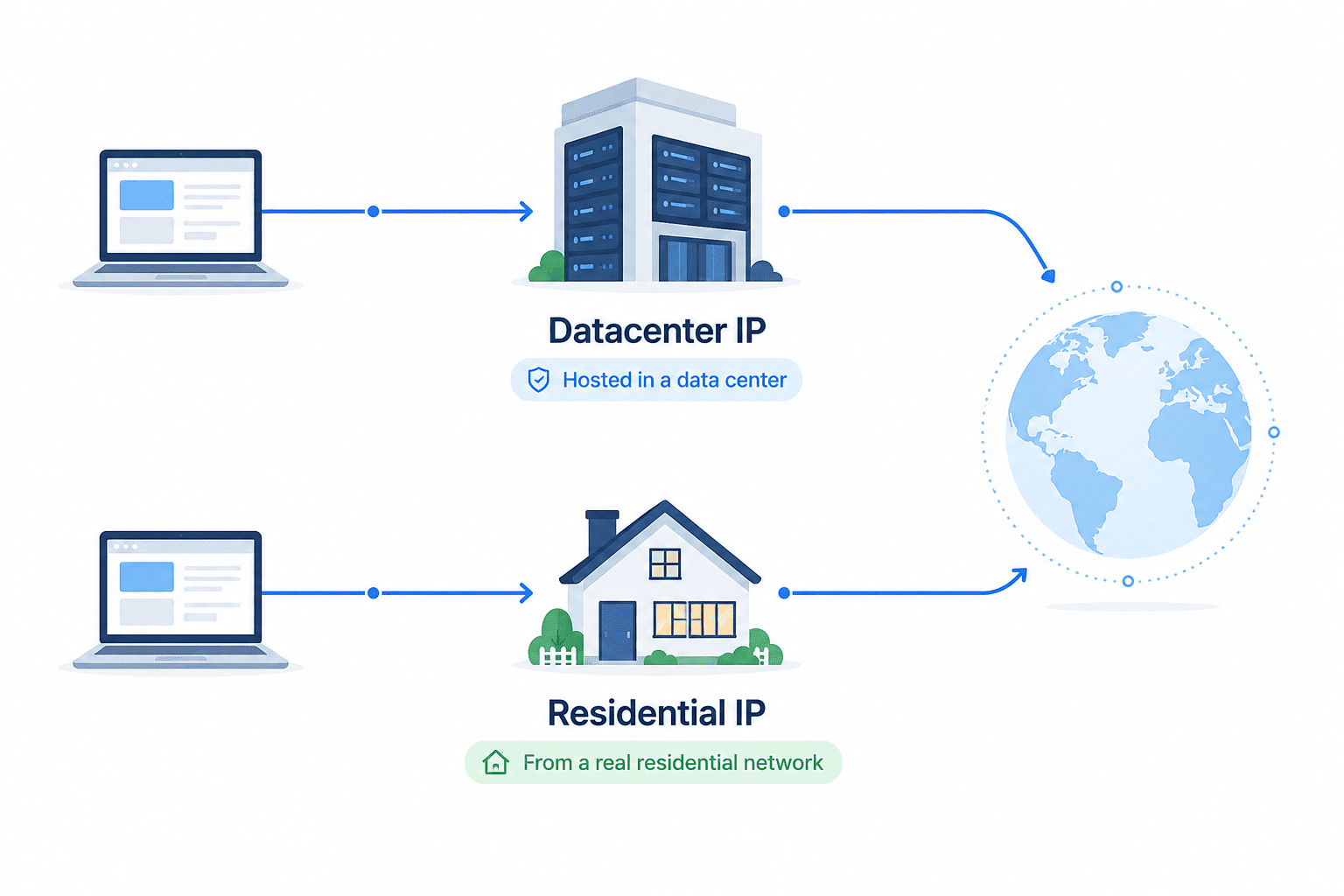
Let’s first understand what datacenter proxies are. Datacenter proxies are IP addresses that come from commercial data centers, not from an internet service provider. They’re created in bulk by cloud hosting companies and proxy providers, which is why they are very fast and cheap. Since they aren’t tied to any home connection, they don’t carry the same trust as residential proxies, which is why they’re much easier to flag as non-human traffic.
Datacenter proxies work well when you need raw speed and don’t need to worry too much about blending in with regular traffic. They’re built for volume, not for looking like a actual real person browsing the internet.
What Are Residential Proxies?
Residential proxies route your traffic through real IP addresses assigned by ISPs to actual homes and devices. When you use one, your request looks like it’s coming from an actual person browsing on their home wifi, because technically, it is.
This is exactly why residential proxies are so much harder to detect. Websites can’t easily tell the difference between a residential proxy user and a genuine user, and that’s what makes them a great option for tasks where getting blocked would cost you time and money.
Are you looking for premium Datacenter or Residential proxies? Then check out Express Nodes.
Premium Proxy Infrastructure
Residential Proxies
🏡
Your content goes here. Edit or remove this text inline or in the module Content settings. You can also style every aspect of this content in the module Design settings and even apply custom CSS to this text in the module Advanced settings.
ISP IPs
🏡
Your content goes here. Edit or remove this text inline or in the module Content settings. You can also style every aspect of this content in the module Design settings and even apply custom CSS to this text in the module Advanced settings.
Fresh IPs
🏡
Your content goes here. Edit or remove this text inline or in the module Content settings. You can also style every aspect of this content in the module Design settings and even apply custom CSS to this text in the module Advanced settings.
Dedicated IPs
🏡
Your content goes here. Edit or remove this text inline or in the module Content settings. You can also style every aspect of this content in the module Design settings and even apply custom CSS to this text in the module Advanced settings.
Key Differences Between Datacenter and Residential Proxies
Here’s a side-by-side look at how the two compare across the factors that actually matter when you’re choosing between them.
|
Factor |
Datacenter Proxies |
Residential Proxies |
|
IP Source |
Cloud servers and data centers |
Real ISPs, assigned to home devices |
|
Speed |
Very fast, low latency |
Slower, depends on the home connection |
|
Detection Risk |
Higher, easier to flag and block |
Lower, blends in with organic traffic |
|
Cost |
Cheaper, often priced per IP |
More expensive, usually priced per GB |
|
Best For |
High-volume, low-security targets |
Sites with strong anti-bot protection |
|
IP Pool Size |
Smaller, more limited |
Much larger and more diverse |
Datacenter proxies trade legitimacy for speed and cost savings. Residential proxies trade some speed for a much higher success rate on protected sites. It really depends on your use case, what you’re trying to do, and how strict your target website is. Based on that, you can choose the option that actually works for you instead of just picking whatever’s cheaper.
When Datacenter Proxies Make Sense
Datacenter proxies are great when speed and budget are your priorities. Here are a few cases where they’re an excellent choice for you.
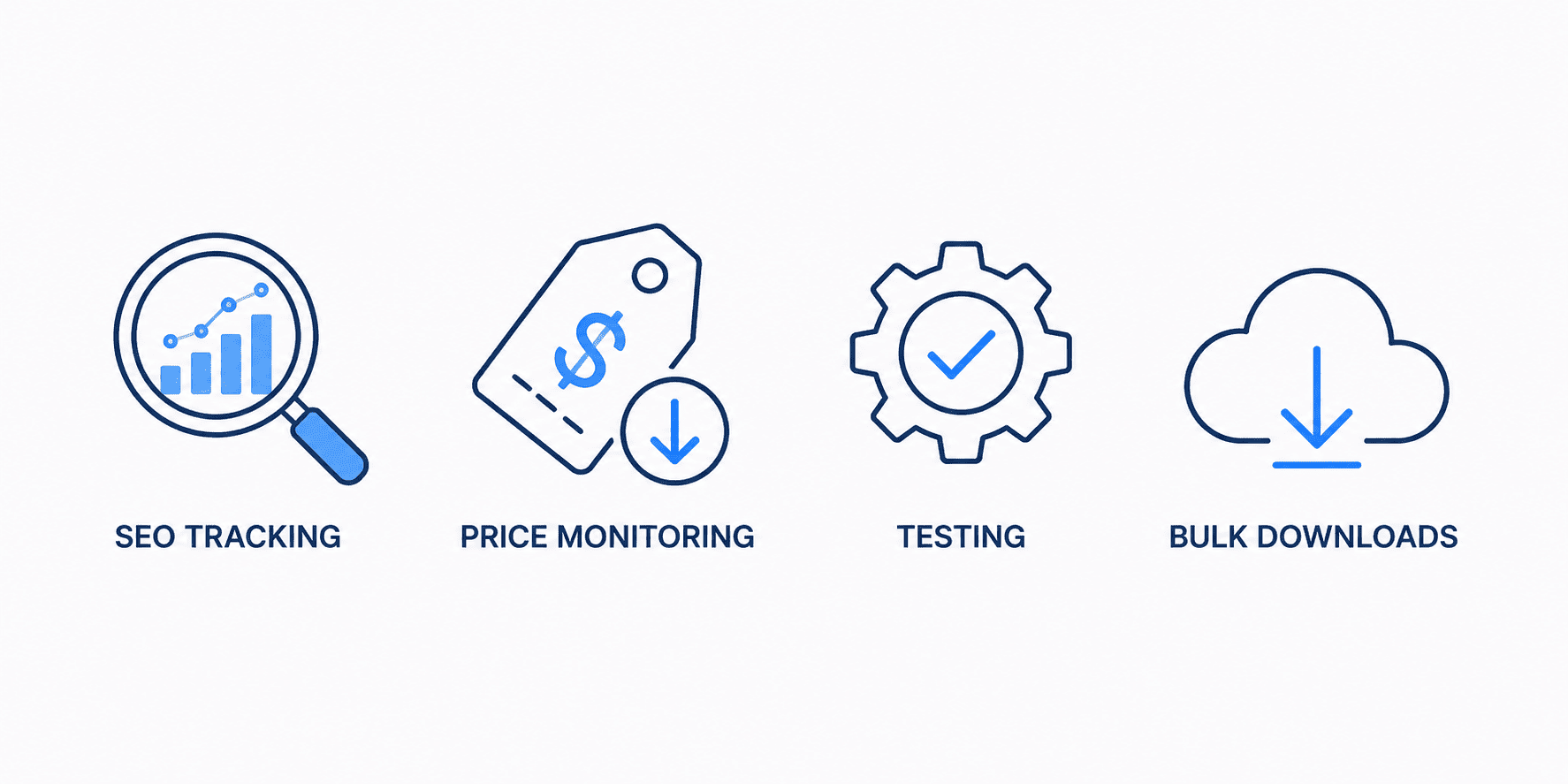
SEO rank tracking: Search engines are fairly tolerant of datacenter traffic, especially at moderate volumes, so tracking keyword rankings across regions works really well here without needing anything fancier or more costly.
Price monitoring on lightly protected sites: There are so many small ecommerce sites that don’t run heavy bot protection, so datacenter proxies are a good choice in this case because they get the job done at a fraction of the cost of residential ones.
Internal testing: If you’re checking how your own website behaves across regions or CDNs, you don’t need residential-level anonymity for that. You’re not trying to fool anyone; you’re just testing your own setup.
High bandwidth tasks: Bulk downloads or large data transfers are far cheaper on datacenter proxies since pricing usually isn’t tied to gigabytes used, unlike most residential of the plans.
When Residential Proxies Are Worth It
Residential proxies are worth it when your target website is very strict and actively tries to separate bots from humans. This includes:
Scraping protected ecommerce and social platforms: Sites running Cloudflare or similar systems block datacenter proxies very easily, sometimes an entire IP range at once. That’s why in this case, using residential proxies is the smarter choice, even at a higher cost.
Ad verification: Advertisers need to see ads exactly as a real user in a real location would see them, and that’s only reliably possible through residential proxies, since the whole point is checking what a genuine visitor sees.
Managing multiple social media accounts: Platforms link accounts that share the same IP pattern and can flag or ban all of them together. Residential proxies, especially rotating ones, make each account look like it’s coming from a different real user in a different place.
Accessing geo-restricted content: Since residential IPs are spread across so many different locations worldwide, they give you much more accurate geo-targeting than datacenter IPs, which tend to be concentrated in fewer regions.
If your work involves any of the above, it’s worth budgeting for residential proxies from the start rather than switching over after you’ve already been blocked a few times.
For a closer look at another proxy option worth knowing about, check out our guide on dedicated proxies, especially if having one consistent IP matters more to you than rotation does.
So, Which One Should You Choose?
Start by looking at what your target website actually does. If it’s a low-security website or an internal tool, datacenter proxies are a good option for you; they get the job done at a much lower cost without any real downside. But if you’re dealing with a platform that actively watches for bot traffic, like a major ecommerce platform or a social network, residential proxies are the better choice because they’re far more difficult to detect.
The most experienced teams don’t pick just one. They use a combination of datacenter and residential proxies depending on the task. They route the easy, high-volume traffic through datacenter proxies to keep costs down, and save residential proxies for the tougher jobs where success rate matters more than speed. If your workflow needs both, working with a proxy provider that offers dedicated support across proxy types makes switching between them a lot easier than juggling separate vendors for each one.
This is exactly the kind of setup Express Nodes helps clients build, whether that means starting with cost-effective datacenter proxies for simple tasks and scaling into residential proxies as your scraping or automation needs get more demanding. If you’re not sure where to start, our pricing page breaks down plans for both proxy types so you can compare before committing.
Is a datacenter proxy or residential proxy better for web scraping?
It depends on the target site. Datacenter proxies work fine for scraping sites with light or no bot protection, and they’re much cheaper for high-volume jobs. For sites with strong anti-bot systems, residential proxies have a noticeably higher success rate.
Are residential proxies always more expensive than datacenter proxies?
Yes, in almost all cases. Residential proxies cost more because providers have to source real IPs from ISPs and real users, which involves more infrastructure and compliance work. Datacenter IPs are cheaper to generate and maintain in bulk.
Can websites detect datacenter proxies?
Often, yes. Datacenter IPs come from known server ranges, so anti-bot systems can flag and block them, sometimes an entire subnet at once. This is far less common with residential IPs since they’re tied to real ISP networks.
Do datacenter proxies work for social media management?
They’re generally not recommended for this. Platforms are good at spotting patterns when multiple accounts share data center IPs. Residential or rotating residential proxies are the safer choice for managing multiple accounts.
Is it legal to use datacenter or residential proxies?
Yes, both are legal for legitimate use cases like market research, price monitoring, and public data collection. What matters is how you use them; always respect a website’s terms of service and applicable data protection laws.
Wrapping Up
Datacenter and residential proxies aren’t competing products. These tools are built for different jobs. Datacenter proxies win on speed and cost, while residential proxies win on trust and detection resistance. The right choice comes down to what you’re trying to access and how much that website cares about catching bots.
If you’re still not sure which setup fits your project, get in touch with our team and we’ll help you figure out a proxy strategy that actually matches your use case instead of guessing and hoping it works.
How to Hide Your IP Address: Proxies vs VPNs vs Tor
About 23% of internet users aged 16 and over said they used a VPN in the second quarter of 2025, based on GWI survey data in the Digital 2026 Global Overview Report. That's nearly one person in four online, and most of them want the same thing, which is to stop...
How to Set Up a Proxy in Chrome: Complete Guide
Chrome accounted for 69.39% of worldwide browser market share in August 2026, according to Statcounter Global Stats. That's a lot of people who will eventually want to browse from a different IP address. So if you want your browsing to go through a proxy, you will...

How to Check if a Proxy Is Working: 7 Easy Methods
The global proxy server market is projected to grow from $1.746 billion in 2025 to $2.649 billion by 2031, a 7.2% CAGR driven mainly by rising cybersecurity needs and demand for geo-restriction bypass. A lot of that growth is actually coming from businesses scraping...