

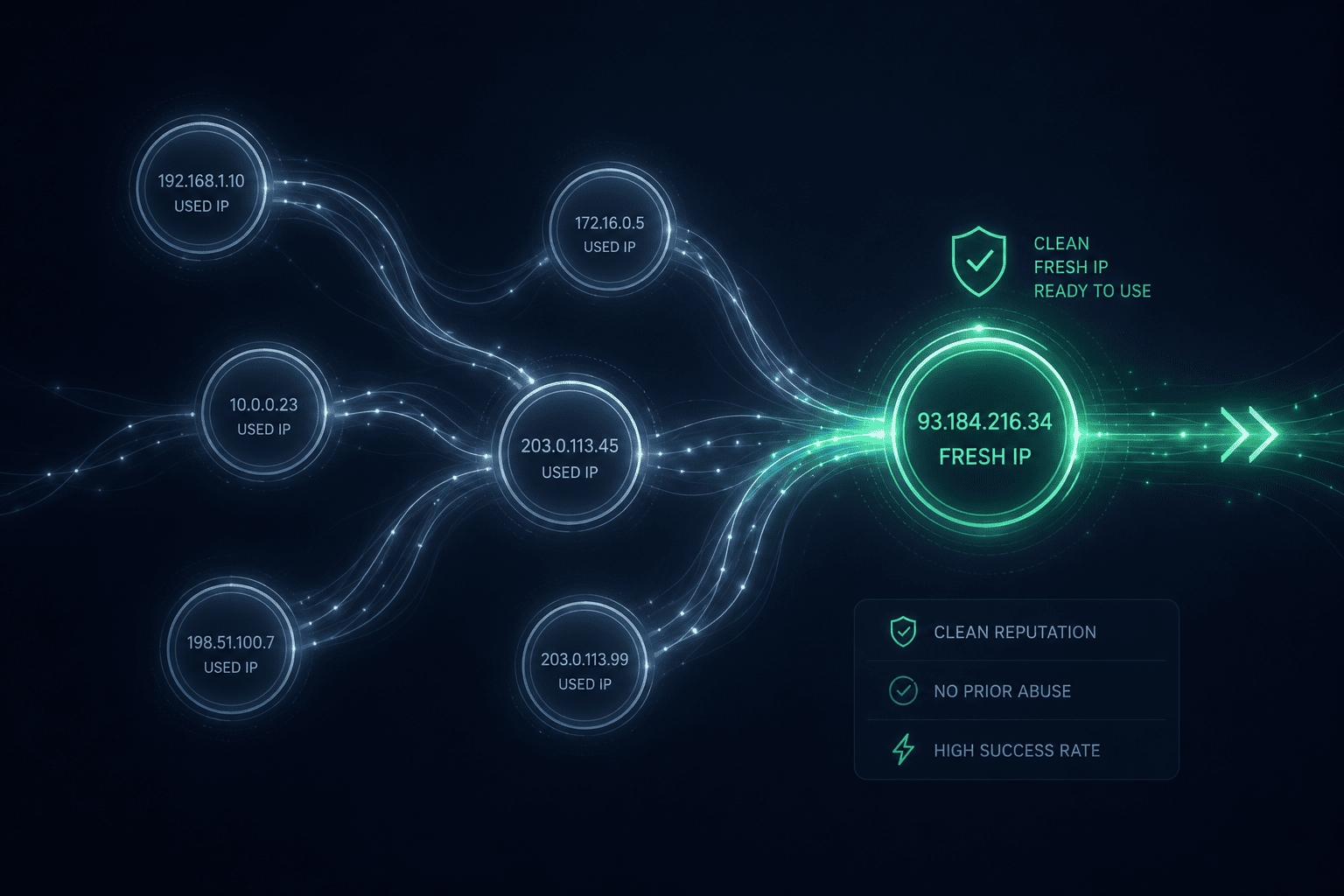
Every time you send a request through a proxy, that IP carries history with it. If the IP was previously used to scrape data, run bots, or access restricted content, websites already have it flagged. That flagged IP may become a huge problem for you. According to a 2023 report by HUMAN Security, over 20% of internet traffic is bot-related, and platforms have become better at detecting and blocking suspicious IPs. When you use an IP that is already on a blocklist, you are not anonymous, you are just flagged under someone else’s name.
This is why fresh proxies exist in the market. A fresh IP has no prior activity attached to it. No ban history. No reputation damage. No flags. It is a clean starting point, and for tasks where anonymity is extremely important, that clean start will make a really big difference for you. In this guide, we will see how fresh proxies work, how to use them correctly, and the mistakes most people make that slowly destroy their anonymity without realizing it.
What Makes a Proxy Fresh in the First Place
A proxy is considered fresh when it has not been used in any significant way before. It has not been used for tasks like scraping, automation, account creation, or any activity that triggers the anti bot systems.
Fresh IPs are typically sourced from residential or ISP networks that have not yet been passed through bulk proxy pools. That matters because most proxy providers reuse IPs across multiple users. One user scrapes aggressively, gets the IP flagged, and then that same IP gets handed to the next person in the pool. You may get their previously flagged IP.
A truly fresh proxy comes to you without that baggage. Platforms like Google, Cloudflare, Instagram, and LinkedIn run real-time reputation checks on every IP that connects to them. A fresh IP passes those checks. A burned one does not.
Are you looking for fresh IPs? Then check out Express Nodes.
Why Anonymity and Fresh Are Not the Same Thing
People often think that using any proxy makes them anonymous, but that is not how it works.
Online anonymity depends on three things: a clean IP, normal behavior, and a consistent fingerprint. A fresh proxy handles the first part. But if you need to send 500 requests per minute through that fresh IP, the IP gets flagged within hours. Now it is no longer fresh.
The proxy is a tool. How you use it determines whether it actually protects you.
Premium Proxy Infrastructure
Residential Proxies
🏡
Your content goes here. Edit or remove this text inline or in the module Content settings. You can also style every aspect of this content in the module Design settings and even apply custom CSS to this text in the module Advanced settings.
ISP IPs
🏡
Your content goes here. Edit or remove this text inline or in the module Content settings. You can also style every aspect of this content in the module Design settings and even apply custom CSS to this text in the module Advanced settings.
Fresh IPs
🏡
Your content goes here. Edit or remove this text inline or in the module Content settings. You can also style every aspect of this content in the module Design settings and even apply custom CSS to this text in the module Advanced settings.
Dedicated IPs
🏡
Your content goes here. Edit or remove this text inline or in the module Content settings. You can also style every aspect of this content in the module Design settings and even apply custom CSS to this text in the module Advanced settings.
How to Use Fresh Proxies for Maximum Anonymity
1. Start with the Right Type of Fresh Proxy
Not all fresh proxies are created equal. The type you choose matters depending on what you are trying to do.
Fresh residential proxies come from real devices on home internet connections. They are the hardest for platforms to detect because they look exactly like a regular user browsing from home. These are ideal for tasks involving social media, ad verification, and account management.
Fresh ISP proxies combine the clean appearance of residential IPs with faster speeds. They are assigned by internet service providers directly, which gives them a high trust score with most platforms.
For pure web scraping at scale, fresh rotating residential proxies give you a clean IP on every request, which means even if one IP gets flagged mid-session, it has already rotated to the next one.
Express Nodes provides fresh proxies across all three types, with IPs sourced from real residential and ISP networks that have not been burned through overuse.
2. Use One IP Per Account or Session
One of the fastest ways to compromise anonymity is IP mixing. If you manage ten accounts and they all share the same IP even a fresh one platforms can cross-reference them and identify the common point. This is called IP linkage, and it is a standard method used by fraud detection systems.
The rule is pretty simple: one IP per account. If you are running multiple sessions or managing multiple accounts, each one should have its own dedicated fresh IP. This is where fresh, dedicated proxies are worth trying, because they are not shared with anyone else.
3. Do Not Reuse a Fresh IP After High-Volume Activity
This is the mistake most people are making. They get a fresh proxy, use it for a very heavy scraping job, and then try to use that same IP for something that requires a clean reputation. The IP is no longer clean. The high-volume activity has already signaled unusual behavior to anti-bot systems.
Once you have used a fresh proxy for something aggressive, retire that IP for sensitive tasks. Rotate to a new one.
4. Match Your Proxy Location to Your Target
Geo targeting is a big part of staying undetected. If you are accessing a US based platform and your fresh IP comes from a completely unrelated country, that inconsistency alone can raise red flags, especially on platforms that track user geography over time.
Most of the good proxy providers let you select IPs by country, state, or city. When anonymity is your goal, pick a location that makes sense for your use case. If you are verifying US ads, use a US based fresh IP. If you are scraping UK product data, use IPs from the UK.
Express Nodes offers geo targeted fresh proxies across multiple regions, so you can match the IP location to whatever you are working on without compromising on the quality of the IP itself.
5. Rotate Intelligently, Not Just Frequently
Rotation is essential for anonymity, but random or too frequent rotation can actually hurt you. Some anti bot systems track the pattern of IP changes. If your IP rotates every two seconds with no logical session structure, that pattern itself is a signal.
A better approach is session based rotation. Keep the same fresh IP for the duration of one logical session, one user journey, one account interaction, one scrape cycle, and then rotate. This replicates how a real user behaves online and it is much harder to flag.
Most proxy providers, including Express Nodes, offer session based rotation settings so you can control exactly when and how often your IP changes.
6. Pair Fresh Proxies with Clean Browser Fingerprints
Your IP is just one part of your online identity. The other part is your browser fingerprint, things like your user agent string, screen resolution, timezone, language settings, and cookie behavior. If your browser fingerprint stays the same across all the different fresh IPs, advanced systems can still track you across sessions.
That’s why for maximum anonymity, you can use a different browser profile for each session when rotating fresh IPs. Tools like AntiDetect browsers are designed specifically for this purpose. The combination of a fresh IP and a clean browser fingerprint is much more effective than either one alone.

Common Mistakes That Burn Fresh Proxies Fast
Getting fresh proxies is just the first step. Here is where people go wrong after that:
Running too many requests per minute through a single IP without any throttling. Even a fresh IP behaves suspiciously if it sends 1,000 requests in two minutes.
Not setting proper headers. Requests without standard browser headers look like bots. Always include realistic user agent strings and accept-language headers.
Using fresh IPs on platforms they were already tested on. Some providers test their IPs before selling, and those test requests can show up in platform logs.
Ignoring HTTPS. If you are routing sensitive traffic through HTTP, the privacy benefit of a fresh proxy is largely wasted. Always use HTTPS.
How Express Nodes Keeps Proxies Fresh
The quality of a fresh proxy depends entirely on how the provider sources and manages their IP pool. Express Nodes maintains freshness by continuously rotating new IPs into the network and retiring IPs that show signs of wear from prior use.
IPs are sourced from legitimate residential and ISP networks, which means they come with natural trust scores rather than the low scores that come from data center IPs. They are also not shared across bulk pools the way cheaper providers do, which means when you get an IP from Express Nodes, it is not carrying someone else’s history along with it.
What are fresh proxies?
Fresh proxies are those IPs that haven’t been used much before, so that they don’t carry any previous ban history. That matters because most of the websites check an IP’s reputation the moment it connects.
How often should I rotate fresh proxies to stay anonymous?
Usually, per session works best, not per request, because switching IPs every few seconds looks just as odd as never switching at all. Stick with one IP for a session, then move to the next one. That’s how a normal person browses.
Can I reuse a fresh proxy after a scraping job?
=
Not really, if anonymity is the goal. Once an IP has been used for heavy scraping, it’s already raised some flags. You should probably pick up a new one.
What's the difference between fresh proxies and anonymous proxies?
Fresh means the IP has no history. Anonymous means it hides your real IP address from the site you’re visiting. You can have one without the other, but for the best results you need both of them at once.
Do I need a fresh proxy for every account I manage?
If you’re running multiple accounts on the same platform, yes. Using one IP across all of them is exactly what fraud detection systems search for. One IP per account keeps things clean.
Final Thoughts
If staying undetected matters for your work, whether that is scraping, ad verification, social media management, or competitive research, starting with an IP that is actually clean is very important.
Fresh proxies give you a clean reputation. But a clean reputation only stays clean if you treat it properly. Use session-based rotation. Match your proxy location to your target. Retire IPs after high-volume tasks. Pair them with clean browser profiles. And always get your fresh proxies from a provider that actually controls the quality of their IP pool.
Anonymity online is not just about hiding your IP. It is about making your traffic look like it belongs there.
If you need fresh residential proxies, fresh ISP proxies, or undetected proxies for any of your use cases, explore Express Nodes’ proxy plans and start with IPs that are actually clean.
Best Proxies for Reddit Account Management
If you manage more than one Reddit account, you already know how quickly things can go wrong. One day your posts are getting traction, and the next day your account is shadowbanned, and you have no idea why. Reddit does not take moderation lightly either. In the first...
Sticky Sessions Explained: When You Need the Same IP for Longer
Imagine that you are logged into an Instagram account through a proxy. You post a caption; everything looks fine. Then you refresh the page thirty seconds later, and suddenly you're logged out, or sometimes it's even worse: the account gets flagged for suspicious...
Best Proxies for Sneaker Copping and Limited-Release Drops
A hyped release goes live. You refresh, you click, and the size you wanted is gone before the page even finishes loading. That's not bad luck. Nike alone says its SNKRS app fields an average of 12 billion bot calls a month, with bots making up anywhere from 10% to 50%...