

If you have ever bought proxies, you must have seen these terms before – HTTP, HTTPS, and SOCKS5. You may have gotten confused seeing these terms because they look too technical. Most people choose whatever sounds a bit familiar, but all of these terms have a specific job, and once you understand that, you can choose one that is the most suitable for your work. If you make a mistake and buy the wrong one, it can lead to slower speeds, failed connection.
There are different kinds of proxy protocols, and they are not built the same way. According to a 2023 report by Zscaler, over 86% of cyberattacks happen over encrypted channels, which makes it really important for us to understand how your proxy handles traffic. So now let’s understand HTTP, HTTPS, and SOCKS5, what each one of these actually does, where it works best, and how to actually decide which one you need.
What Is an HTTP Proxy?
HTTP stands for HyperText Transfer Protocol. It is actually the foundation of how data is moved across the web. An HTTP device sits between your device and the website you are visiting, passing the web requests back and forth.
It works in a very simple way. Your browser sends a request to the proxy. The proxy forwards it to the website, gets the response, and sends it back to you. The website actually sees the proxy’s IP address, not yours.
HTTP proxies are actually really good for basic web browsing, scraping static web pages, and situations where the speed matters more than the security. They are very lightweight and fast because there is no encryption overhead.
Are you looking for premium proxies? Then check out Express Nodes
Premium Proxy Infrastructure
Residential Proxies
🏡
Your content goes here. Edit or remove this text inline or in the module Content settings. You can also style every aspect of this content in the module Design settings and even apply custom CSS to this text in the module Advanced settings.
ISP IPs
🏡
Your content goes here. Edit or remove this text inline or in the module Content settings. You can also style every aspect of this content in the module Design settings and even apply custom CSS to this text in the module Advanced settings.
Fresh IPs
🏡
Your content goes here. Edit or remove this text inline or in the module Content settings. You can also style every aspect of this content in the module Design settings and even apply custom CSS to this text in the module Advanced settings.
Dedicated IPs
🏡
Your content goes here. Edit or remove this text inline or in the module Content settings. You can also style every aspect of this content in the module Design settings and even apply custom CSS to this text in the module Advanced settings.
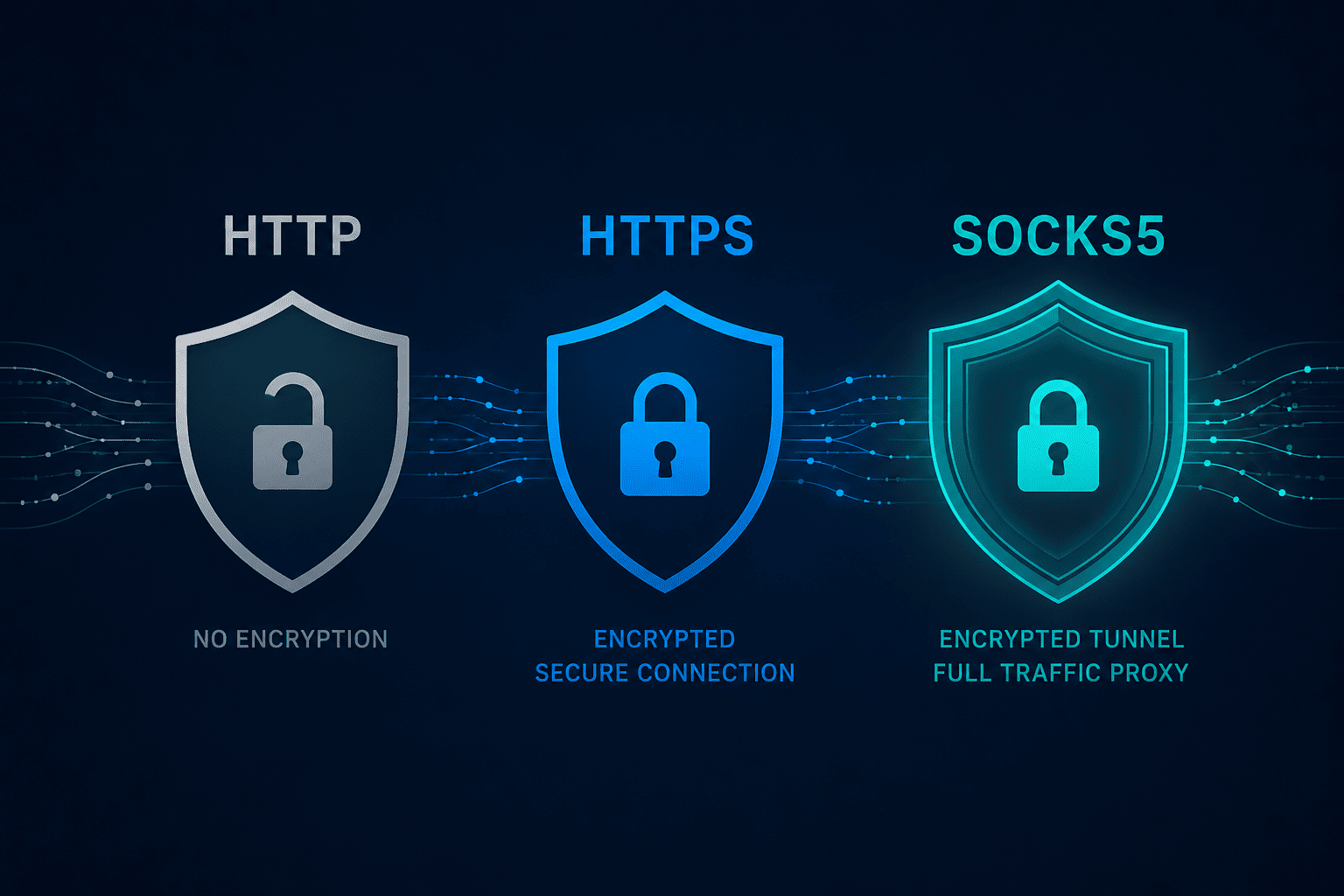
What Is an HTTPS Proxy?
HTTPS is HTTP with a layer of encryption added to it, powered by SSL/TLS. When you visit a website that starts with “https://”, that padlock in your browser means your connection is encrypted. An HTTPS proxy works in the same way it handles the encrypted traffic between you and the website.
HTTPS proxies are a great choice for anything sensitive, like account management, ad verification, and e-commerce scraping or accessing those platforms that require authentication. If the website uses HTTPS (Most of website actually use it). Using an HTTPS proxy keeps that encryption end-to-end.
HTTPS proxies are a bit slower than HTTP proxies due to the encryption, but for most of the use cases, the difference is barely noticeable. Since it is more secure, it is actually worth it.
What Is a SOCKS5 Proxy?
SOCKS5 is completely different from both of them. HTTP and HTTPS are completely built for web traffic. SOCKS5 can actually handle any type of traffic, like HTTP, HTTPS, FTP, torrents, gaming data, and email.
A few things that make SOCKS5 stand out
Authentication support– SOCKS5 supports username and password authentication natively, which gives you an extra layer of control over who can use the proxy.
UDP support-Unlike HTTP and HTTPS proxies, SOCKS5 actually supports UDP (User Datagram Protocol), which is used in applications like gaming and video streaming.
No data modification-Because SOCKS5 does not inspect or modify the traffic, it actually tends to have lower error rates and better compatibility across many different platforms.
Check out premium proxies by Express Nodes
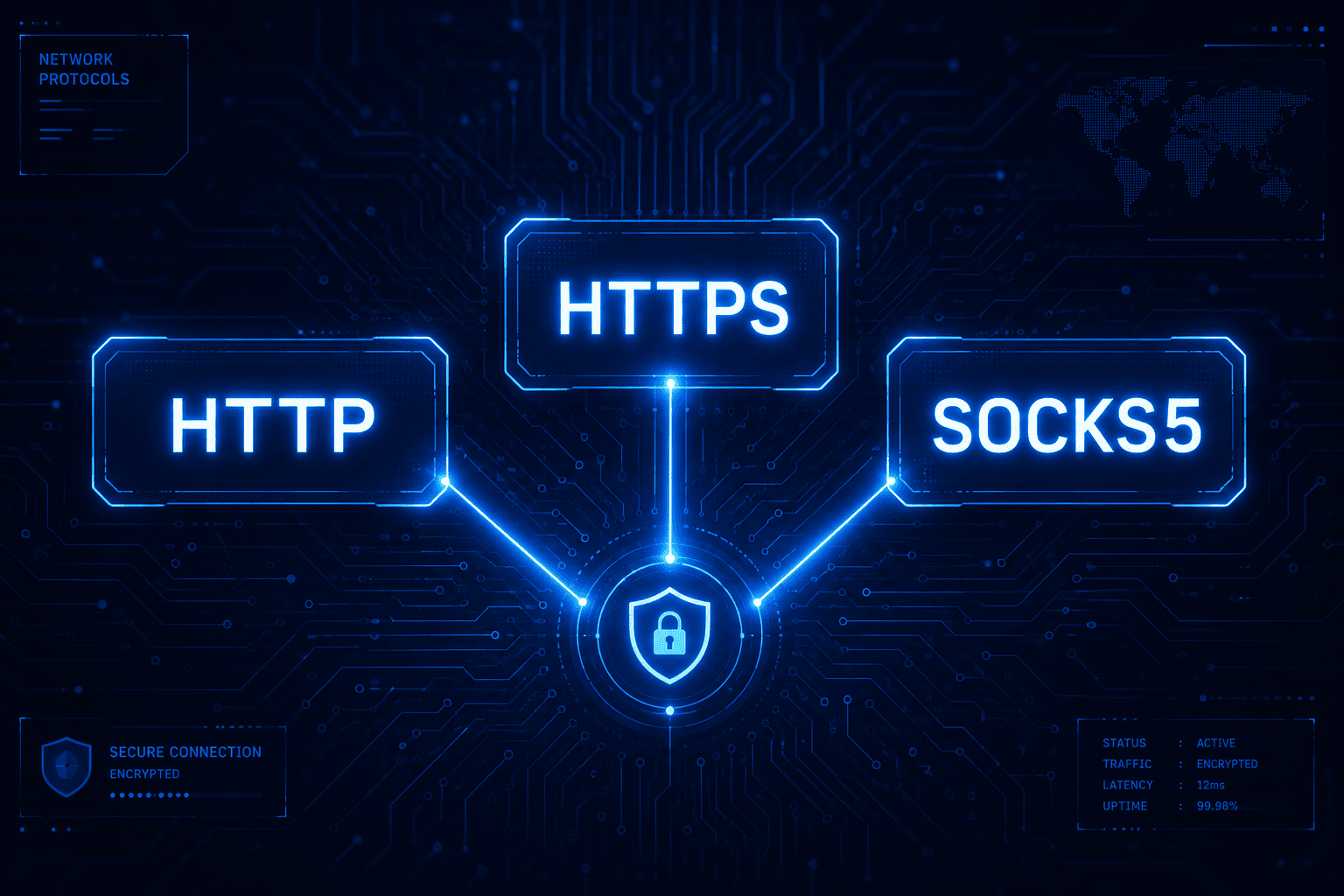
HTTP vs HTTPS vs SOCKS5: Side-by-Side
Here is a quick look at how these three compare across the most important factors:
|
Feature |
HTTP |
HTTPS |
SOCKS5 |
|
Encryption |
None |
Yes (SSL/TLS) |
No (needs external encryption) |
|
Traffic type |
Web only |
Web only |
Any (HTTP, FTP, UDP, etc.) |
|
Speed |
Fastest |
Slightly slower |
Fast |
|
Anonymity |
Basic |
Good |
High |
|
Use with apps |
Limited |
Limited |
Very flexible |
|
Authentication |
Basic |
Basic |
Yes (username/password) |
Which One Should You Use?
It completely depends on what your use case.
HTTP Proxies– If you are scraping data that is publicly available from websites that do not require a login, and speed is your top priority. It is really good for large-scale data collection where privacy is not the main concern.
HTTPS Proxies-If you are dealing with authenticated sessions, scraping sites that use SSL, running ad verification tasks, or managing multiple social media accounts. HTTP is actually a very safe choice.
SOCKS5 Proxies-If you need maximum flexibility. Whether you are running bots, using applications outside the browser, working with torrents, streaming content, or building automation workflows that span multiple, SOCKS5 handles it all.
If you are still unsure, then I suggest you go with SOCKS5 because it is the most popular choice, and most serious proxy users prefer it.
Take a look at premium proxies by Express Nodes
What is the difference between HTTP and HTTPS proxies?
HTTP sends the data in plain text, so anyone can read it if intercepted. HTTPS actually encrypts data, so nobody can read it. Use HTTP for basic scraping and HTTPS for sensitive information.
Is SOCKS5 better than HTTPS for web scraping
It actually depends on your use case if you are scraping; HTTP is better for encrypted websites, and SOCKS5 is better when you need flexibility across different tools.
3)Which proxy protocol is fastest?
HTTP is the fastest among the three of them, but honestly the difference between all three is very small. You will barely notice it.
Can I use SOCKS5 with my browser?
Yes, most of the browsers actually support it. You can set it up in your browser or proxy settings. Most of the scraping tools and bots actually support it.

Shared vs Dedicated Proxies: Which Fits Your Use Case?
If you have even spent ten minutes shopping for proxies, you have probably faced this problem before. Every provider's page asks whether you need shared or dedicated proxies, and if you don't know what that means, let me help you. Here's a number worth looking at:...
Best proxies for eBay and Etsy sellers
Marketplace sellers rarely think about proxies until something goes wrong. A second store gets flagged for "suspicious activity." A price-tracking script gets rate-limited after twenty requests. A perfectly legitimate second shop gets linked to the first one and both...

Best Proxies for Reddit Account Management
If you manage more than one Reddit account, you already know how quickly things can go wrong. One day your posts are getting traction, and the next day your account is shadowbanned, and you have no idea why. Reddit does not take moderation lightly either. In the first...